CodeRabbit vs Tomosu: Code Review and a Reliability Gate on the Same Pull Request
Written by the Tomosu team, so read it as a vendor's comparison. CodeRabbit details come from CodeRabbit's public pricing page and docs, checked November 2, 2026.
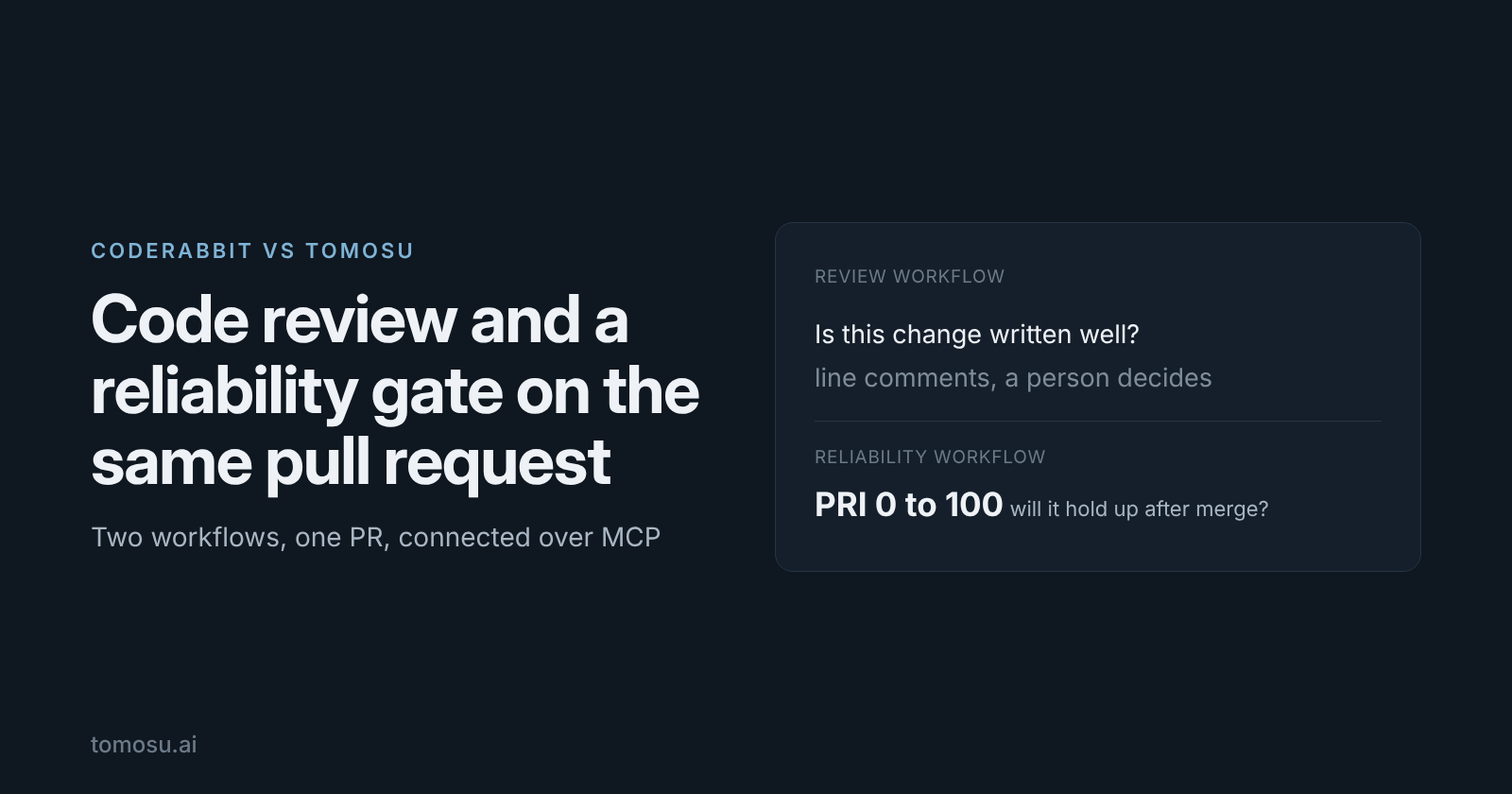
CodeRabbit runs a review workflow. A change comes in, the bot comments on it, and a person decides. Tomosu runs a reliability workflow. The repository has a score, every change is scored against it, the merge is gated on the result, and production data feeds back into the score. The two connect over MCP, so most teams don't have to pick one.
The short version:
- CodeRabbit asks whether a change is written well.
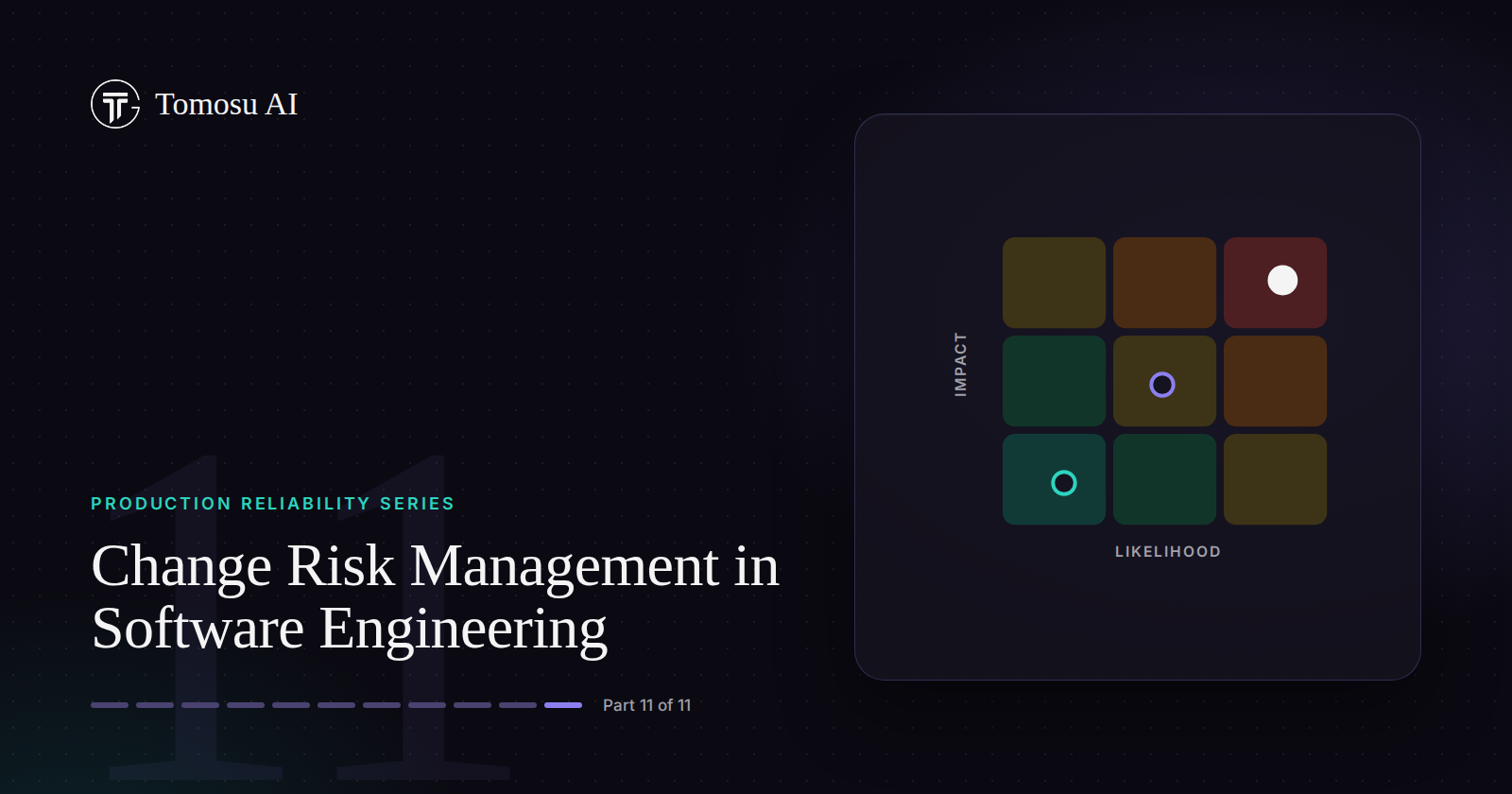
- Tomosu asks whether the system will still hold up once the change merges, scores that from 0 to 100 as a Production Reliability Index (PRI), and lets a merge gate act on it.
- If you want line-by-line review, keep CodeRabbit and plug Tomosu into it.
Two workflows for the same pull request
The review workflow (CodeRabbit)
- A developer or coding agent opens a pull request.
- CodeRabbit reads the change, with context from the rest of the codebase and any linked repositories.
- It posts a summary and line-by-line comments, and can suggest or apply fixes.
- A person reads the comments and decides whether to merge.
The output is advice. It works when someone reads it, and the merge decision stays with whoever presses the button.
The reliability workflow (Tomosu)
- Tomosu scans the whole repository and gives it a PRI from 0 to 100, broken into eight sub-indexes.
- While the change is being written, the VS Code plugin and the MCP server show how it moves that score, to you and to your coding agent.
- When the pull request opens, the GitHub App posts the score change on it.
- If the score is under the threshold you set, the Tomosu Git Agent won't open or auto-merge the pull request.
- On the Team plan, production logs, metrics and traces from a runner inside your network feed back into the score.
The output is a number with findings behind it, and the rule for acting on it is set before anyone looks at the change.
text
                        PULL REQUEST
                    /                 \
   REVIEW (CodeRabbit)                 RELIABILITY (Tomosu)
   line-by-line comments               repo scored, PRI 0 to 100
          |                                    |
   a person reads and triages          score in editor, agent and PR
          |                                    |
   the reviewer decides the merge      gate at your threshold
                                               |
                                 production data feeds back into the score

           MCP connects the two: Tomosu's score shows up in CodeRabbit's review
How they connect over MCP
CodeRabbit can call Tomosu's MCP server during a review, so the reliability score lands in the same pull request thread as the review comments. Coding agents can call the same server while they write the change, so the agent sees the score before any reviewer, human or bot, does.
In CodeRabbit, open Review, then Integrations, then the MCP Servers tab. Add the Tomosu MCP server URL, pick OAuth, sign in with the Google account tied to Tomosu, and enable all 8 tools. One person sets it up for the whole CodeRabbit org. The setup guide has the details.
What a reliability finding looks like
These are blind scans of real open-source bugs, each with the success criterion fixed before the scan:
- IBM ContextForge. The pre-fix
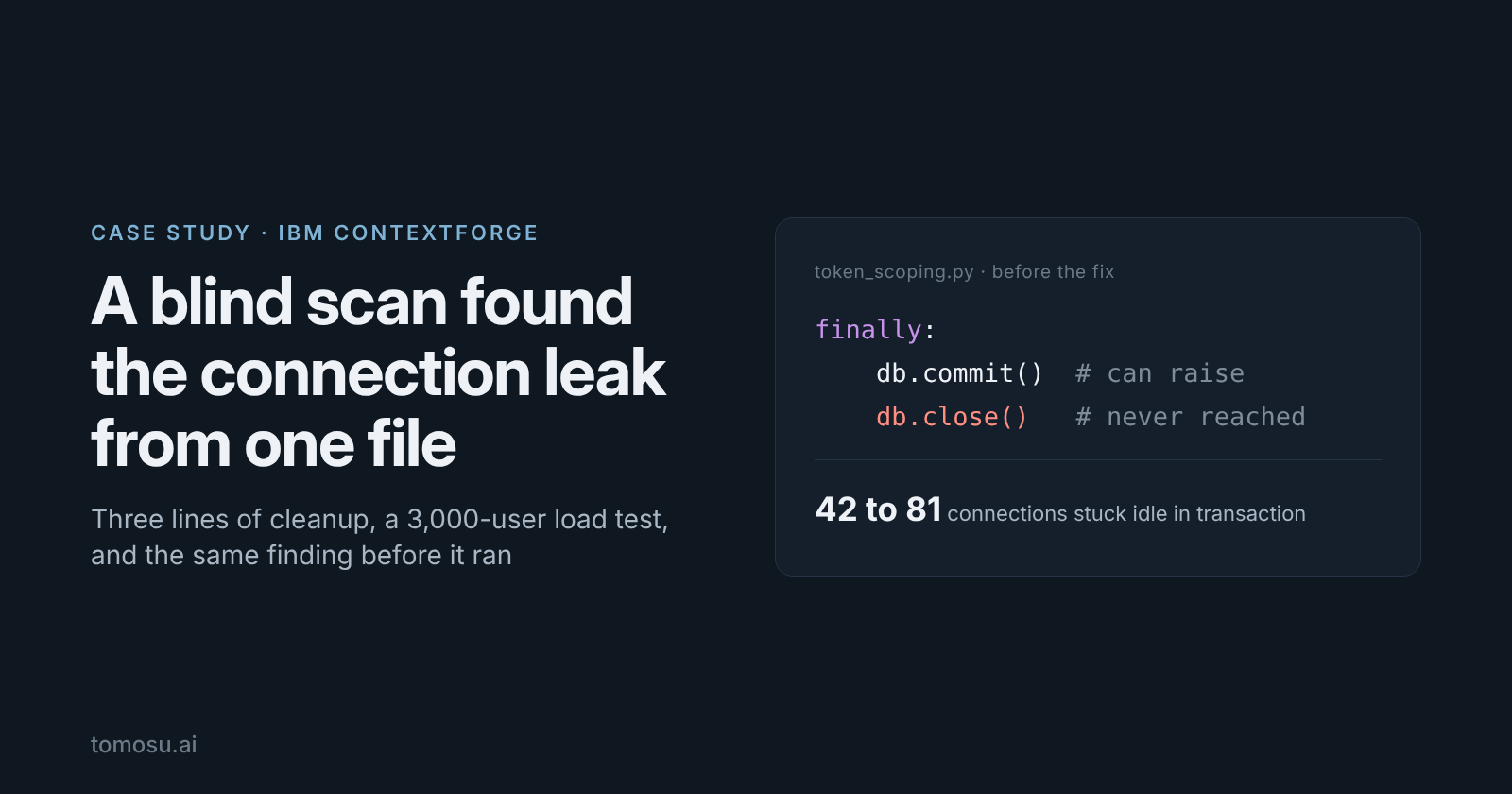
token_scoping.pyscored PRI 27. The scan flagged the unsafe session cleanup behind PostgreSQL connections sittingidle in transactionuntil the pool ran out. Case study - Celery. The pre-fix
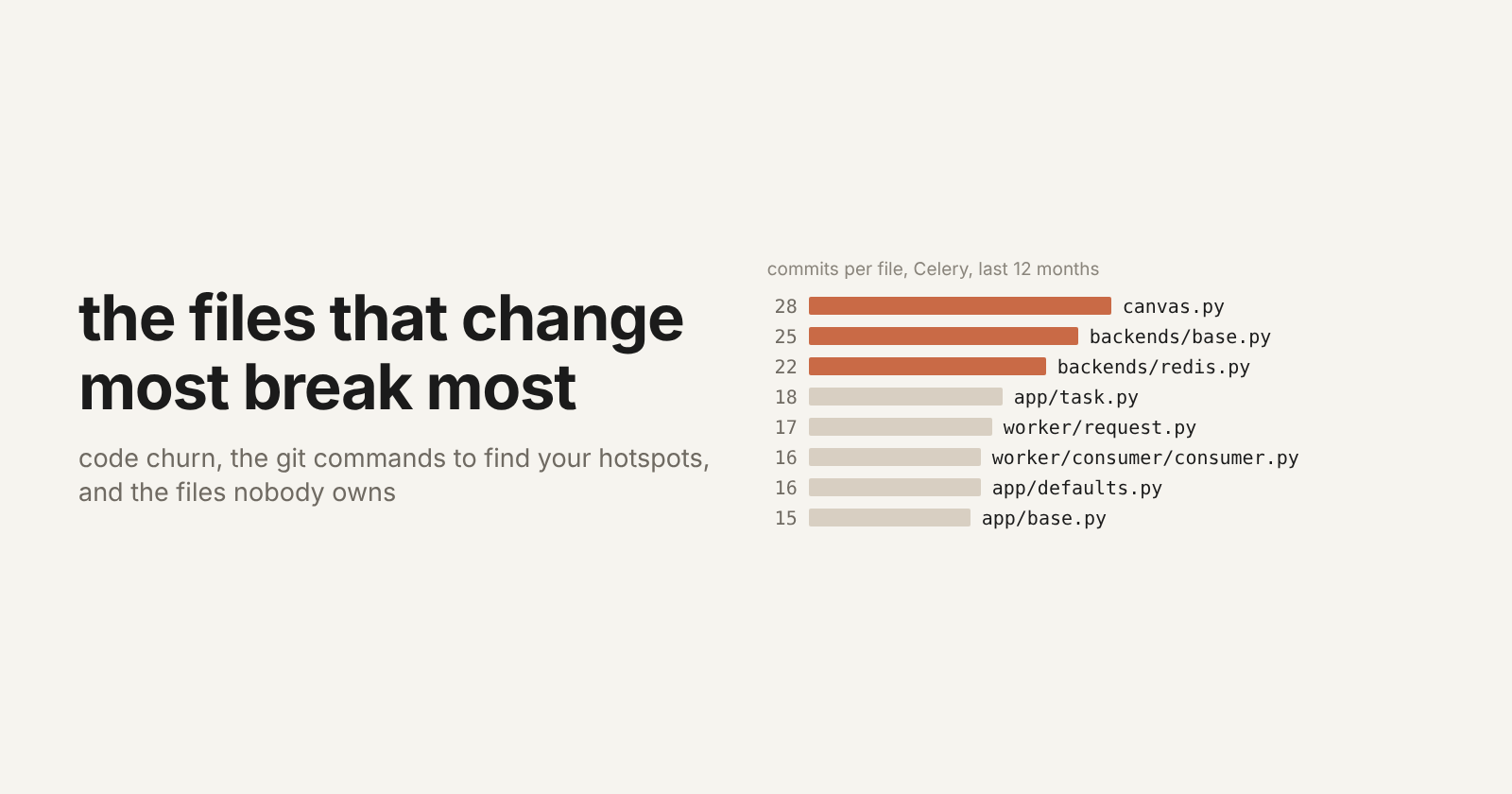
events/state.pyscored PRI 30. The scan found the unbounded memory growth first reported in 2018 and recommended a bound that matches the one maintainers shipped in 2026. Case study - Prefect. Given only a traceback, Tomosu named the file, function and root cause of a negative-timeout crash in
pause_flow_run, and the case study lists the one thing it missed. Case study
What the reliability workflow checks
The pre-merge rules cover about 59 categories, weighted toward the failures that page on-call engineers:
- concurrency safety, the largest group
- database performance and transaction boundaries
- error handling, including swallowed and misclassified failures
- connections, streams and handles that are never released
- timeouts, retries, backoff, and whether a circuit breaker exists
- async messaging: ordering, duplicate delivery, poison messages
An LLM proposes candidate findings. A fixed scoring matrix of 375 pre-merge rules and 265 runtime rules decides what counts, with the weights applied in Tomosu's own code, so rescanning unchanged code doesn't give a different verdict. Rules that need history the scanner can't see (incidents, alerts, git history) are switched off on a code-only scan rather than guessed.
Because the score covers the whole repository, a change that looks clean in its own diff can still lower it: a connection opened and never released, a retry loop with no backoff, a transaction that now wraps a network call.
How the merge gate works
You set one threshold. If nobody sets it, it's 40 out of 100. When the Tomosu Git Agent opens or merges a GitHub pull request or a GitLab merge request, it checks the branch score first. Below the threshold, the call is refused with a 422 that carries the score, the threshold and the reason.
On GitHub, before an auto-merge, the agent also checks commit status, test and CI check runs, at least one approving review, no conflicts, and that the branch isn't behind. Each check is a toggle, so both the review and the reliability score can be required to pass before anything merges. On GitLab the score is the check the agent adds; the rest is left to GitLab's own merge rules.
Two design choices to know about. The gate sits on Tomosu's own write path, so a merge done directly in GitHub's or GitLab's UI goes around it. And if Tomosu's scoring service is unreachable, the action goes ahead, because a reliability tool that takes your pipeline down during its own outage has failed at its one job.
Side by side
| CodeRabbit (review) | Tomosu (reliability) | |
|---|---|---|
| Question it answers | Is this change written well? | Will the system hold up after it merges? |
| Unit of work | The pull request, with codebase and linked-repo context | The repository, then each change against it |
| Output | Summaries, line-by-line comments, suggested fixes | A 0 to 100 PRI with eight sub-indexes and findings by category |
| Who decides the merge | A person reading the review, plus any pre-merge checks you configure | A threshold set in advance (default 40/100), checked by the Git Agent |
| Where you see it | Pull request, CLI, IDE | VS Code plugin, coding agent via MCP, pull request |
| Production signals | CI results, such as failed builds | Logs, metrics and traces through a runner in your network (Team and Govern) |
| Git hosts | GitHub, GitLab, Azure DevOps, Bitbucket | GitHub, GitLab |
| Pricing model | Per user: $24, $48 or $72 a month; Enterprise custom | Metered, no seats: Free (250 TCUs once), Starter $39/mo, Team $99/mo, Govern custom |
Pricing
CodeRabbit charges per user, so a 10-person team on Essentials pays $240 a month at the monthly list price. Tomosu doesn't count seats. It meters TCUs, roughly 34 KB of code read and analysed per unit, at ten cents each on paid plans. A large repo costs more than a small one however many people work on it, and adding developers or agents uses no TCUs. Plans and pricing has the full breakdown.
Other CodeRabbit alternatives, by workflow
| Tool | Workflow | Pick it if |
|---|---|---|
| Greptile | Review | Your codebase is large or tangled and reviews need repository-wide context |
| GitHub Copilot code review | Review | You're on GitHub and want review without adding a vendor |
| Qodo / PR-Agent | Review | You want an open-source reviewer you can self-host |
| Cursor Bugbot | Review | Your team already writes code in Cursor |
| SonarQube | Static analysis gate | You want deterministic rule checks with quality gates that fail the build |
| Tomosu | Reliability gate | You want a production reliability score per repo and change, a merge gate on it, and runtime evidence feeding it |
When the review workflow is all you need
Tomosu isn't the right tool in four cases:
- You only want a reviewer that comments on every line. CodeRabbit is built for that. Tomosu won't catch your missing nil check and isn't trying to.
- Security review is the main job. CodeRabbit sells security review and repository scans. Tomosu's rule set is mostly reliability, with a small security slice.
- You want policy as code. Tomosu's gate is a single threshold number. There's no rules language, no YAML, no DSL.
- You're on Bitbucket or Azure DevOps, or your code is mostly PHP, Kotlin, Swift or C++. CodeRabbit supports both hosts. Tomosu covers GitHub and GitLab and doesn't read those four languages yet.
Security and your code
Your code is never used to train models. Scopes are read-only. The runtime runner dials out, so there are no inbound ports and no agent on production hosts. Secrets are filtered before anything leaves your network, isolation is per customer, and you set retention and deletion. Govern adds self-hosted runners, dedicated tenancy and data residency.
Supported languages: Python, JavaScript and TypeScript (including JSX and TSX), Java, C#, Ruby, Scala, Rust, Go, C, shell, Terraform, XML and config files.
FAQ
Is Tomosu a replacement for CodeRabbit? They run different workflows. CodeRabbit reviews changes and leaves comments for a person to act on. Tomosu scores reliability and gates merges on that score. Teams that want both connect them over MCP, and CodeRabbit posts Tomosu's score next to its own review.
What's the difference between AI code review and a reliability gate? AI code review produces comments for a person to read and act on. A reliability gate produces a score and a pass or fail rule set before the change arrived.
What can stop a pull request from merging if AI-generated code is likely to break production? Tomosu's Git Agent refuses to open or auto-merge a pull request when its reliability score is below your threshold. SonarQube quality gates do something similar for static analysis rules through branch protection.
Does Tomosu block merges made in the GitHub or GitLab UI? No. It gates pull requests and merge requests that go through the Tomosu Git Agent, and it lets actions through if Tomosu is unreachable.
To try the reliability side on your own code, run a free scan. The free plan includes 250 TCUs and needs no card.
Originally published on tomosu.ai.
About the author
- Tomosu continuously scores every application and closes its reliability gaps across development, pre-merge and runtime, using the Production Reliability Index (PRI) and a multi-tier agentic system.
Comments
Join the discussionNo comments yet. Be the first to comment.