Change Risk Management in Software Engineering
Learn how change risk management works in software engineering, from pre merge analysis and dependency context to deployment controls, runtime signals, and incident feedback.
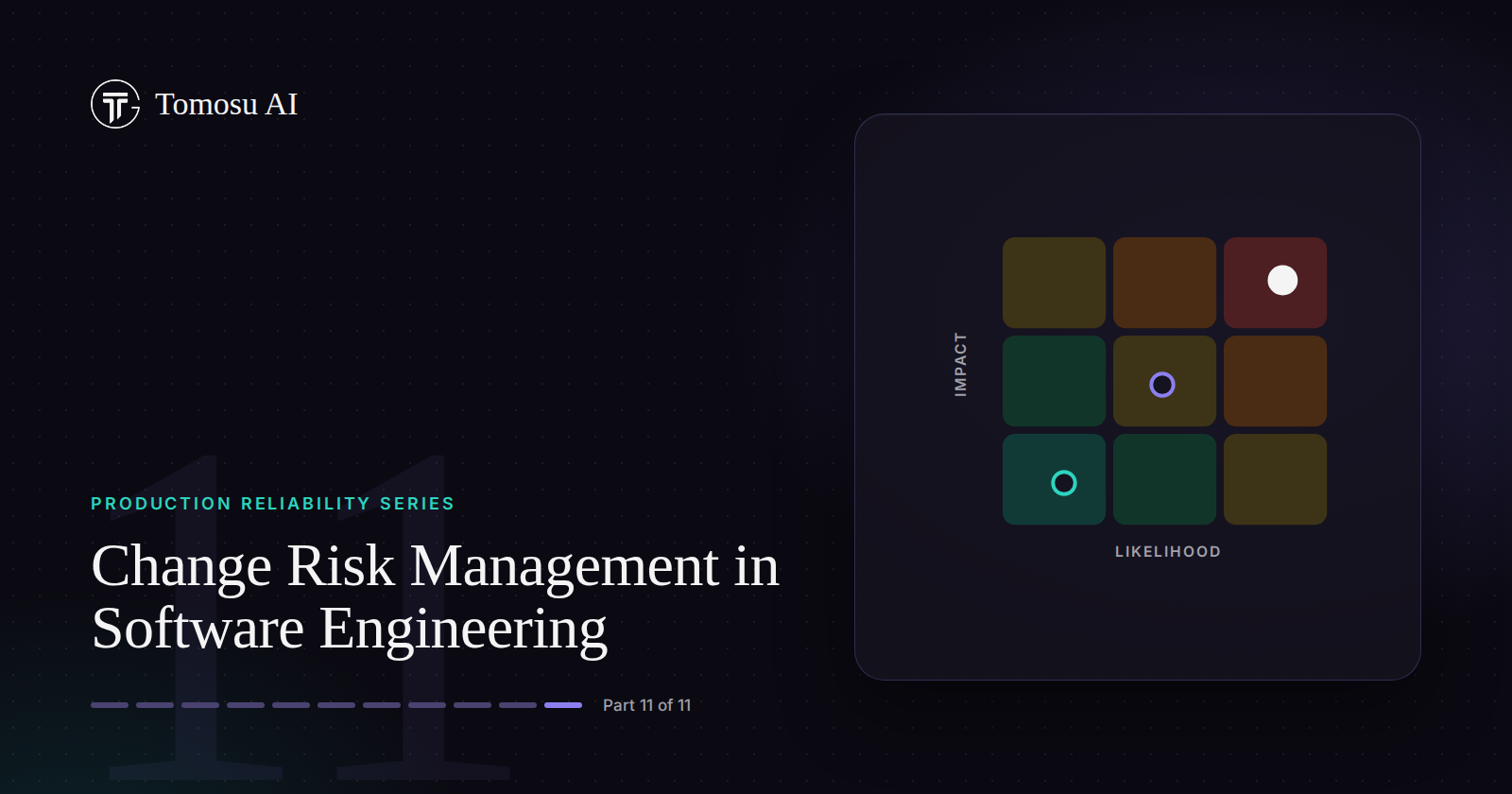
Change risk management is the process of understanding and controlling the potential production impact of software changes. It is not one tool or one review step.
A useful lifecycle is:
Change → Review → Verification → Deployment → Runtime → Incident feedback → Future changes
Before merge
Examine change scope, dependencies, affected components, testing, production usage, incident history, and potential blast radius.
During deployment
Use appropriate controls such as staged rollout, feature flags, monitoring, rollback procedures, and approvals.
After deployment
Runtime signals show whether the change behaves as expected. Errors, latency, dependency behavior, traffic changes, and incidents can provide evidence.
Why the loop matters
An incident can produce more than a fix. It can reveal which component was fragile, which dependency mattered, which signal was missing, which test should exist, or which deployment control could have reduced exposure.
AI changes the volume of change
AI coding tools can increase the number of changes teams produce. That makes surrounding verification and governance more important. The goal is not to slow AI assisted development, but to keep higher change volume from automatically meaning less understanding of production impact.
Tomosu's Production Reliability Index (PRI) provides a reliability signal around changes as part of a broader production reliability workflow.
Explore PRI: https://tomosu.ai/start
About the author
- Tomosu continuously scores every application and closes its reliability gaps across development, pre-merge and runtime, using the Production Reliability Index (PRI) and a multi-tier agentic system.
Comments
Join the discussionNo comments yet. Be the first to comment.
The Production Reliability Series
A practical series on production reliability, covering how to evaluate software changes, dependencies, blast radius, testing, observability, pull request risk, and reliability before deployment.