Your AI-Assisted PRs Are 2.5x Bigger. Nobody Adjusted the Review Process.
Code Review Automation Fixed the Wrong Problem
LinearB looked at 8.1 million pull requests across 4,800 teams. PRs written with AI assistance sit at over 400 lines at the 75th percentile. Without AI assistance, that number is 157. The code got written faster and shipped in bigger chunks, but review didn't scale with it: pickup time on AI-assisted PRs averages 16+ hours, versus about 200 minutes otherwise. A month out, only a third of them have merged.
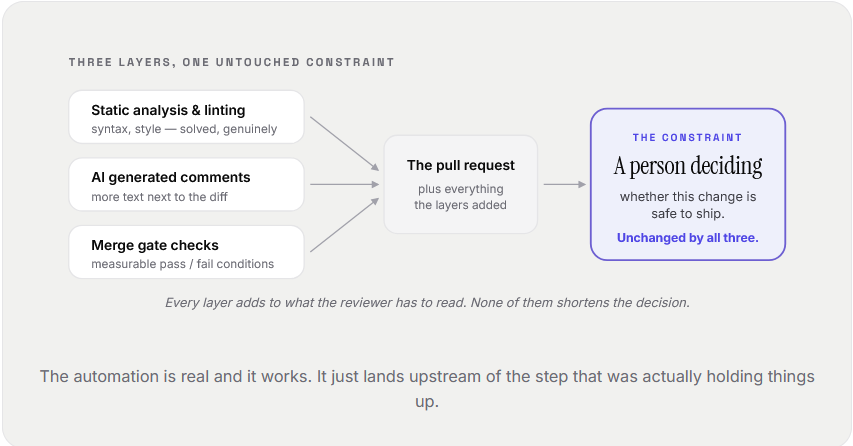
That gap is where most "code review automation" tooling lives right now, and it's worth being precise about what it actually does. Static analysis, AI review comments, CI merge gates. All of it operates on the "what's wrong with this line" question. None of it touches "should this ship, and what happens if it's wrong," which is the actual decision holding up the queue.
Faros AI calls the result the "senior engineer tax": the people best equipped to judge a subtle, high-reach defect are the ones sitting on the biggest backlog, because everything mechanical got cleared through first and dumped on them.
Full breakdown, including the case for scoring pull requests by reach instead of size: tomosu.ai/blogs/code-review-automation